

What is Cosmeticorexia? A brief introduction to this new condition
The beauty and the cosmetics These are sectors which, in recent years, have seen a rise in consumption. And this is largely because the public is discovering new cosmetic products and ingredients through the product recommendations constantly being put out by celebrities and fashion influencers.
‘Exia’is a suffix that was used in ancient Greece to refer to a ‘state of‘, but which today, in Spanish, would roughly mean ‘disorder‘ or ‘illness‘- is a newly coined term defining a condition that would involve «purchasing and using a large number of ‘anti-ageing’ cosmetic products at a young age’ -childhood / adolescence-, based on the beauty advice they receive on social media -mainly TikTok and Instagram- people with little knowledge of the use and safety of cosmetics (i.e. influencers, models and other beauty content creators)".
Cosmeticorexia: a trend yet to be verified
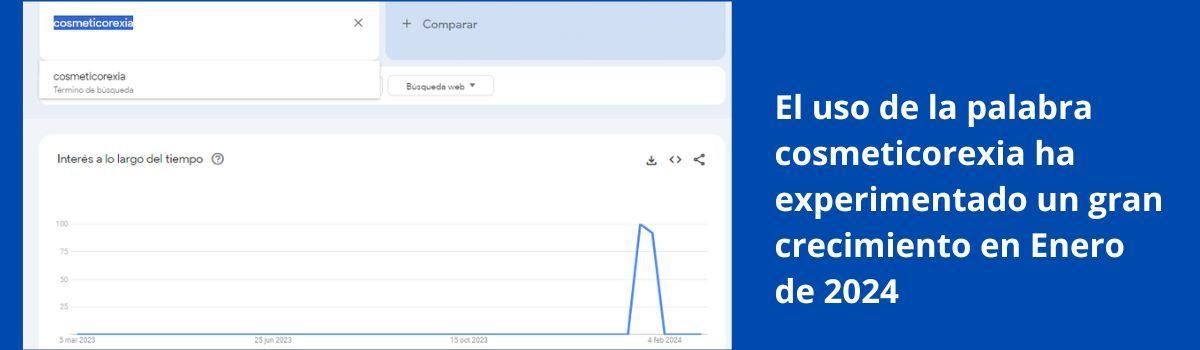
Researching in Google Trends, we see how the term cosmeticorexia It did not start being used on the internet until late 2023. And in fact, looking at the data on this trend, we can conclude that it was In mid-January 2024, this neologism of uncertain origin began to be used on a massive scale on social media around the world, experiencing an unprecedented ‘boom’, becoming a global trend and generating a large number of articles in the mass media.
The cosmetics and beauty tips are much older. But if we take a closer look at the past, we’ll find that most of the advice we used to receive on cosmetics came from the mass media, They came from two very different professional backgrounds:
- People with technical knowledge of dermocosmetics and cosmetics safety
- Marketing and Sales Departments of cosmetics manufacturers (who are obliged to limit product labelling to claims permitted in cosmetics and monitored by Autocontrol to ensure compliance.
These were the key players in the field of communications and marketing within the cosmetics sector. It is worth noting that, beyond sales themselves, there was very little feedback of cosmetic product users. There was no real dialogue with the consumer; they were regarded as mere recipients of this knowledge about cosmetics.
With the rise of social media, many more people have been given a voice across all sectors. And as far as consumers are concerned, this has led to the emergence of a new figure: influencers – people with a large number of followers on social media and the ability to influence their consumption habits. This is, or can be, positive for brands’ communication. But as social media users, we should remember that no give equal weight on the recommendation of a TikToker o influencer rather than that of a dermatology specialist.
Often, social media gives a greater platform to people who are hugely popular and have loads of followers, but who do not have sufficient knowledge to offer effective advice tailored to the general public. Therefore, in our new digital lives, we must to maintain a critical approach to content of unknown origin. And we should bear in mind that, if we come across something new that catches our attention, it is always a good idea to cross-check that information with the views of experts who have extensive knowledge of cosmetics and can offer truly reliable advice on these products, based on scientific evidence.
In this new digital world, where everyone has their own voice and trends are evolving at breakneck speed, there is little point in complaining that this is how things work. On the contrary, we must accept that these voices exist, but at the same time it is necessary to to emphasise the importance of the expert. Someone who has gained extensive expertise in a particular field and who, by virtue of their knowledge and professional background, is objectively well-placed to provide truly reliable information about their sector.
There are currently a large number of experts in dermocosmetics, who have their own channels and social media accounts, and who offer perfectly valid advice. And, of course, these professionals can be useful in answering any queries we may have about cosmetics at any given time. But we must be able to distinguish them from another group: celebrities and influencers who recommend cosmetic products, but do so with errors and inaccuracies, without having any real knowledge of the subject.
Let’s distinguish this type of cosmetics expert from those who are experts solely in social media communication. That is the best way to combat ‘cosmeticorexia’.

Cosmeticorexia: some important points to bear in mind regarding this new trend on social media
The Cosmetic Products Regulation 1223/2009 It provides us with all the information we need to understand what children’s cosmetics are and what factors we need to take into account when launching a cosmetic product aimed at children onto the market. For this reason, we do not believe it is necessary to go into further detail regarding the relevant legislation.
Let’s remember: To date, there is no evidence whatsoever that the cosmeticorexia is spreading amongst children and young people. Nor is there any evidence that this trend has a real impact on the population. The existence of the cosmeticorexia It is understood more as a trend that is currently being observed in private dermatology practices and which, perhaps, should be monitored. To date, there are no studies that allow us to demonstrate, with scientific evidence, what percentage of the population is affected by cosmeticorexia. Nor has it been possible to determine the actual impact this disorder has on human health as a whole and on the groups most susceptible to it: young girls and adolescents.
However, we can say that the emergence of the term ‘cosmeticorexia’ has set alarm bells ringing amongst dermatology specialists (who, since last January, have been offering their views on the phenomenon for articles in the mass media). There is also a certain consensus amongst professionals that the misinformation circulating on social media – in content offering advice on cosmetic products and treatments, produced by so-called ‘cosmetics experts’ – sometimes reaches consumers. And that, if we do not manage to reverse this trend soon, it could end up changing their habits.
In that regard, and to summarise the most important points we should bear in mind regarding the cosmeticorexia, here are some points of interest for the general public:
- On the one hand, we must be aware that Your skin doesn’t have the same needs throughout your life. The ‘anti-ageing products‘ are designed to cover the the skin’s needs as a person reaches middle age and, therefore, probably are neither particularly useful nor the most suitable for girls and teenagers.
- On the other hand, it is important to know that There are a number of ingredients and active substances used in anti-ageing cosmetics -like the retinol- that skin at a young age does not need not at all, and that, because of their side effects or, because of their allergenic potential, they may pose a health risk to younger consumers.
- If we have these basic knowledge of cosmetics, and we are able to to distinguish between cosmetic products aimed at adults and those designed for younger age groups -It’s usually easy to tell them apart by their packaging, but you’ll also find information about this on the label—so you shouldn’t worry about falling into the cosmeticorexia.
- The adults Here at home, we also have another little mission: check which cosmetic products your children use, to ensure that they do not consume products that are not suitable for their age group, particularly those that offer an ‘anti-ageing’ effect’. And to try, as far as possible, to counter these recommendations that girls and teenagers are receiving on social media from people with no knowledge of dermocosmetics, using common sense.
- Finally, both if we notice any kind of skin problem -irritation, the onset of spots, etc…- as if tIf you have any doubts about the use or effects of a cosmetic product For young children, we at GTF M. Camps recommend consult a dermatologist. A skin specialist will always be able to offer personalised advice based on your needs. And, if necessary, they will be able to plan the most suitable treatment for your skin.